DDR5 vs DDR4 for VPS Hosts: When EPYC's 12 Channels Matter

DDR5 vs DDR4 for VPS Hosts: When EPYC’s 12 Channels Matter
For bandwidth-intensive server workloads and future-proof capacity scaling, DDR5 is usually the better choice. For latency-sensitive systems or cost-constrained refreshes, a well-populated DDR4 setup can still hold its own. New builds targeting high-density virtualization or in-memory databases should default to DDR5, while balanced, latency-critical farms nearing end of life may be better off waiting for the next full platform cycle.
TL;DR:
- DDR5 offers significantly higher data transfer speeds than DDR4, with launch speeds of 4800 MT/s and projections up to 8800 MT/s, benefiting bandwidth-bound applications.
- To maximize DDR5’s advantages, platforms need to support multiple channels per socket; for example, AMD EPYC 9004 supports 12 channels and up to 6 TB per socket when fully populated.
- Workloads such as AI training, recommendation engines, and large in-memory caches see the largest performance gains, sometimes up to 7.3 times higher throughput with DDR5.
- Upgrading to DDR5 requires a full platform refresh because it is incompatible with DDR4 motherboards and CPUs, so cost and workload characteristics must be carefully considered.
- Proper configuration, including populating all channels and using one DIMM per channel, is critical for harnessing DDR5’s full speed and capacity benefits during benchmarking and deployment.
Table of Contents
- Architectural differences: bandwidth, latency, subchannels, and on-die ECC
- Server platform implications: memory channels and capacity scaling
- Workload guidance: which server workloads benefit most from DDR5
- Migration and procurement considerations for a fleet refresh
- Practical tuning and testing checklist for benchmarking memory
- How we pick memory for VPS and RDP infrastructure
- Get started with DDR5-capable VPS plans
- Sources
- FAQ
Architectural differences: bandwidth, latency, subchannels, and on-die ECC
The two standards solve different problems. DDR4 tops out around 3200 MT/s in its standard specification, while DDR5 launches at 4800 MT/s and JEDEC has projected speeds climbing toward 8800 MT/s over the platform’s life. Higher MT/s means more data moved per cycle, which is exactly what bandwidth-bound applications want. Latency tells a different story: early DDR5 modules run higher CAS timings measured in cycles, so absolute latency in nanoseconds depends heavily on frequency and controller mode rather than moving in lockstep with the generation.
DDR5 also changes the internal structure of the module itself. Each DIMM is split into two independent 32-bit subchannels instead of one 64-bit channel, which lets the memory controller service more concurrent requests. Combined with on-die ECC, this addresses a real reliability gap: as DRAM cells shrink, they become more prone to bit errors, and on-die ECC corrects those errors inside the chip before they reach the server’s own ECC logic.

Power delivery moved onto the module too. DDR5 DIMMs carry their own power management IC (PMIC), regulating voltage locally instead of relying entirely on the motherboard. That shift supports the lower operating voltage DDR5 runs at and gives server vendors finer control over power delivery at scale.
Server-class memory adds another layer of choice:
- RDIMM (registered) buffers command and address signals, the standard choice for most dual-socket servers.
- LRDIMM (load-reduced) buffers data lines too, enabling higher capacity per DIMM at the cost of a small latency penalty.
- MRDIMM (multiplexed rank) is a newer DDR5-specific format built for higher effective bandwidth.
- x4 vs x8 width matters for reliability: x4-organized chips enable multi-bit ECC on server modules, which matters more as capacity grows.
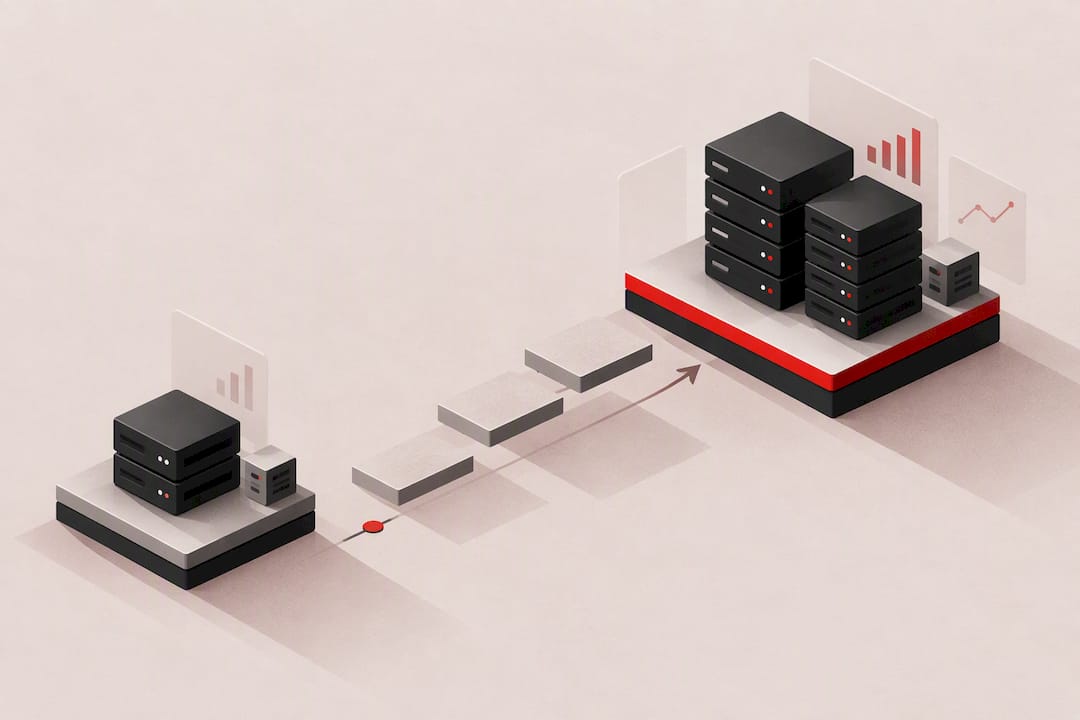
DDR5’s standard launch speed of 4800 MT/s is 1.5 times DDR4’s 3200 MT/s baseline, and that gap widens further as JEDEC-projected DDR5 speeds climb, which is the single biggest reason bandwidth-hungry server workloads move to DDR5 first.
Server platform implications: memory channels and capacity scaling
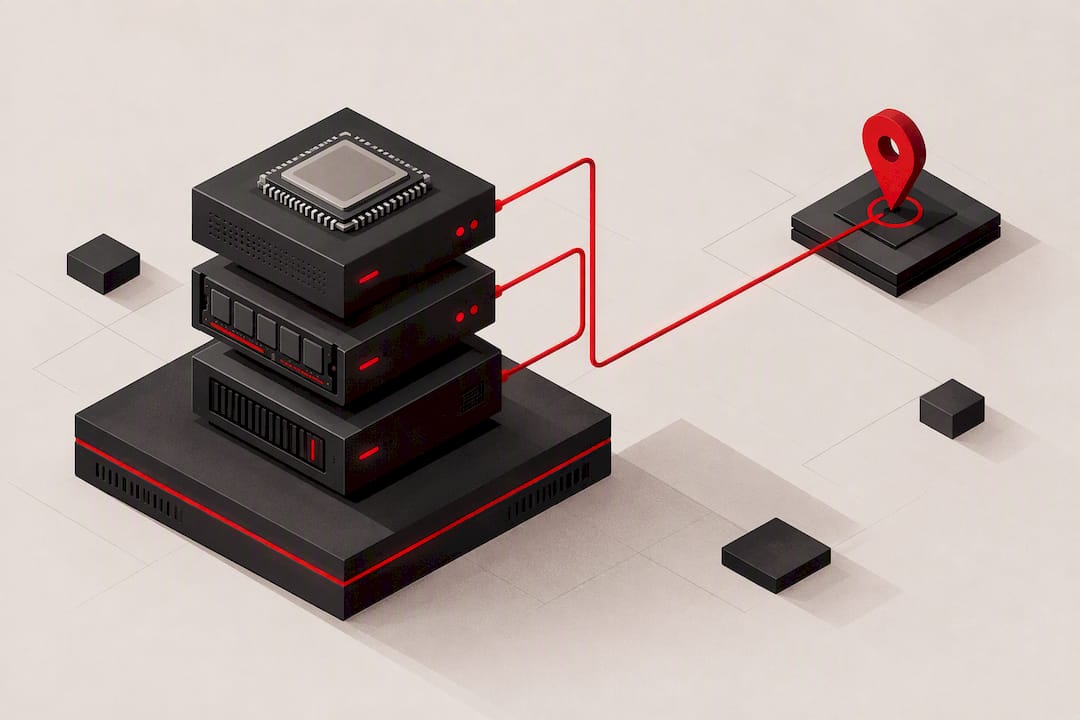
Raw module speed only matters if the platform can feed it. Memory bandwidth on modern servers is a function of channels per socket, DIMMs per channel, and how evenly those channels are populated. AMD EPYC 9004 Series processors expose 12 DDR5 memory channels per socket, support up to two DIMMs per channel, and can address up to 6 TB of DDR5 per socket. That is a substantial jump in both channel count and per-socket ceiling compared to prior DDR4 generations.

Populating every channel is not optional if bandwidth is the goal. A processor with 12 channels but only six populated effectively halves its theoretical memory bandwidth, regardless of how fast the individual DIMMs are rated. The same AMD guidance recommends running 1DPC (one DIMM per channel) across all channels when maximum bandwidth is the priority, since adding a second DIMM per channel (2DPC) can force the memory controller to a lower speed grade to maintain signal integrity.
For virtualization hosts, this translates into concrete configuration choices:
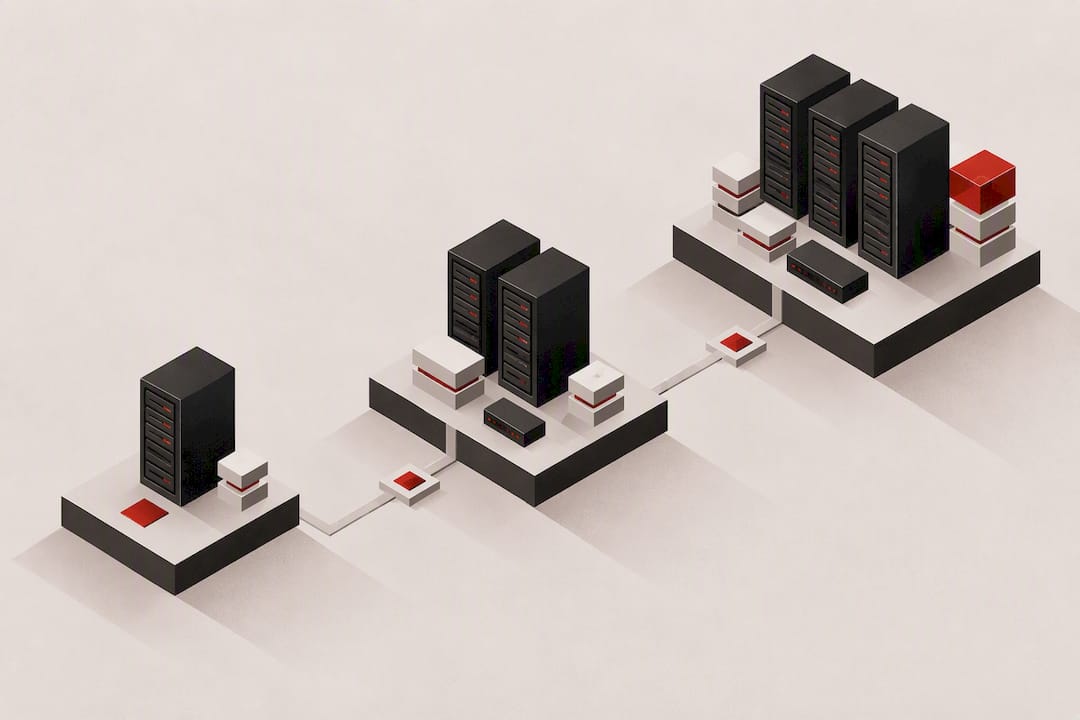
- A single-socket EPYC 9004 host with all 12 channels populated at 1DPC gets full-rated bandwidth with headroom for future DIMM upgrades to 2DPC.
- A dual-socket host doubles both channel count and capacity ceiling, which matters for dense VM consolidation.
- DDR5 is not a drop-in upgrade: it requires a compatible CPU and motherboard, since DDR5 DIMMs are physically and electrically incompatible with DDR4 slots.
| Configuration | Channels per socket | Max DIMMs per socket | Max capacity per socket |
|---|---|---|---|
| AMD EPYC 9004 Series (DDR5) | 12 | 12 (2DPC) | 6 TB |
Workload guidance: which server workloads benefit most from DDR5
Not every workload sees the same lift, and vendor test summaries help set realistic expectations rather than assuming DDR5 wins everywhere by the same margin.
- Bandwidth-bound workloads see the largest gains. Micron’s server DRAM testing recorded up to a 7.3x improvement in image classification throughput and a 4.3x gain in recommendation-system throughput moving from DDR4 to DDR5, making DDR5 a strong default for AI training, recommendation engines, and large in-memory caches.
- Latency-sensitive workloads need testing before switching. High-frequency trading systems and ultra-low-latency VDI deployments can be sensitive to the higher cycle-count CAS timings DDR5 modules carry at launch speeds, so the safest path is benchmarking your actual application rather than trusting MT/s alone.
- High-density VM hosts benefit from capacity as much as speed. When the constraint is how many VMs fit per host rather than raw throughput per VM, DDR5’s higher module densities let you pack more memory into the same channel count.
- Some analytics workloads still favor DDR4 capacity increases. Micron’s own tests found that simply increasing DDR4 capacity improved MS SQL performance by roughly 2.2x in certain configurations, which means a DDR4 capacity bump can be the more cost-effective move for some database workloads rather than a full platform migration.
Micron’s tech brief reports gains as large as 7.3x for image classification and 4.3x for recommendation throughput on DDR5, and those figures apply specifically to the workloads tested rather than as a general multiplier across every application.
Migration and procurement considerations for a fleet refresh
DDR5 is not backward compatible with DDR4 sockets or motherboards, so adopting it means a full platform refresh: new CPUs, new motherboards, and the labor to rack, migrate, and validate each host. That cost needs to be weighed against the incremental benefit for your specific workload mix, since a bandwidth-light fleet may not recoup the expense quickly.
Sticking with DDR4 indefinitely carries its own risk. As CPU vendors shift new silicon to DDR5-only platforms, DDR4 server boards and processors gradually move toward end of life, and vendor support and replacement part availability shrink over time.
A few triggers make the migration case stronger:
- Your current CPU generation is approaching end of life or lacks a DDR4-compatible successor.
- Workload profiling shows genuine memory bandwidth bottlenecks, not just CPU or storage limits.
- Energy efficiency targets favor DDR5’s lower operating voltage and on-module power management.
Pro Tip: Before committing to a full refresh, profile your current fleet’s memory bandwidth utilization; if it rarely exceeds what your existing DDR4 channels can deliver, a capacity upgrade may beat a platform swap on cost. Planning the actual cutover is its own project, and a structured migration checklist helps avoid downtime during the swap.
Practical tuning and testing checklist for benchmarking memory
Comparing DDR5 and DDR4 fairly requires controlling variables that have nothing to do with the memory itself.
- Populate all channels before running bandwidth tests, since partial population understates the platform’s real ceiling.
- Prefer 1DPC where capacity allows, since populating one DIMM per channel typically achieves the processor’s rated maximum speed more reliably than 2DPC.
- Match DIMM ranks and densities across channels and record the BIOS or firmware memory settings used, since mismatched ranks cause uneven interleaving and noisy results.
- Control non-memory bottlenecks like NICs and storage, since I/O throughput cannot exceed what the memory subsystem itself can deliver.
- Run both synthetic and application-level tests, pairing memory bandwidth and latency microbenchmarks with real workload tests like database queries or ML inference.
Pro Tip: Log the configured memory speed reported by the system, not just the DIMM’s rated speed; a 2DPC configuration can silently downclock below the module’s spec sheet number.
How we pick memory for VPS and RDP infrastructure
Running virtualization and remote desktop workloads at scale means memory decisions get made on behalf of hundreds of different customer use cases at once, from lightweight remote access to sustained automation loads. That pushes us toward platforms with headroom on both bandwidth and capacity rather than tuning narrowly for one workload type. Modern AMD Ryzen infrastructure with DDR5-capable hosts can benefit customers running high-throughput development, automation, or multi-session RDP workloads where memory bandwidth becomes the limiting factor before CPU does. The tradeoffs described above, channel population, DIMM density, latency variance, are not abstract for a hosting provider: they show up directly in how consistently a VPS performs under real concurrent load.
— AceRDP
Get started with DDR5-capable VPS plans
If the workload guidance above points you toward DDR5, some Windows RDP and KVM VPS plans run on modern AMD Ryzen hardware with DDR5 memory and NVMe storage, built for the bandwidth and low-latency access that development, automation, and remote desktop workloads depend on. Developers running build pipelines, businesses hosting high-throughput automation, and power users who need responsive remote sessions may benefit from such hosting solutions. Compare the Bronze, Silver, Gold, and other plan tiers and pick the specs that match your workload’s memory demands.
Sources
FAQ
Is DDR4 outdated in 2026?
DDR4 is not obsolete, but it is aging: new server CPU platforms increasingly ship DDR5-only, which gradually shrinks vendor support and new hardware options for DDR4. For workloads that are not bandwidth bound, a well-configured DDR4 system remains a viable, lower-cost option.
Is DDR5 really worth it over DDR4?
It depends on the workload. Micron’s testing shows DDR5 delivering multi-fold throughput gains for bandwidth-heavy tasks like image classification and recommendation systems, while some database workloads see comparable gains just from adding DDR4 capacity.
Is 32GB of DDR5 overkill?
For a general-purpose virtual machine or remote desktop session, 32GB is generous rather than excessive, and the right amount depends entirely on how many concurrent sessions or services the host needs to support. For dense virtualization hosts running many VMs, capacity needs typically scale well beyond that figure.
Is DDR5 actually faster than DDR4?
In raw data rate, yes: DDR5 launches at 4800 MT/s compared to DDR4’s 3200 MT/s standard. Latency is more nuanced, since early DDR5 modules run higher CAS timings in cycles, so the real-world speed advantage depends on the specific workload being run.